Manifesto Multilinko |
|
|
Interesting links and notes on updates to my main website.
![[add RSS feed]](http://www.feedburner.com/fb/images/pub/fb_pwrd8831.gif) ![[add RSS feed]](http://www.feedburner.com/fb/images/pub/feed-icon32x32.png)
[to search, use Blogger search in top bar] NEW BLOG
HOME ---- 
[contact me] My Blogger Profile View my photo galleries. Listen to my radio station. Currently ReadingThis is an Ottawa blog (Ontario, Canada). Cool blogs: McWetlog wood s lot La Tribu du Verbe Wil Wheaton Darren Barefoot Lectio.ca Blogger profiles in Ottawa Other good sites: Slashdot Wired News Mark Morford's Notes & Errata This page uses Extreme Tracker which is determining your referrer by running some JavaScript. 
The commenting system was Reblogger. |
Monday, February 06, 2012
leaving home
This is my 6,626th blog post. I've been blogging here since May 2001. But Google has finally managed to de-feature Blogger to the point where I have to move. So I did. My first post on my new WordPress blog is the sky gods are puzzled – Ottawa urban planning (built form). If you want to follow it, it's http://feeds.feedburner.com/ManifestoMultilinko Thanks for reading me here. Hope to hear from you on WordPress. Bye Blogger. UPDATE 2012-02-09: Kudos to Reblogger for providing a reliable commenting platform for my blog since 2003 (or maybe even earlier). However, now that the new blog is live, I'm shutting down comments here on the old blog. Labels: meta Saturday, February 04, 2012
a rant about Ottawa urban planning (transportation slice)
French urban planner Jacques Gréber turned a dreary lumbertown filled with with noxious industries and wooden office buildings into an attractive modern capital. The scenic parkways along the Ottawa River and Rideau Canal, the Greenbelt, Gatineau Park, the Queensway and the network of parks and greenery that give Ottawa its postcard beauty today all stem from Gréber’s handiwork.Ottawa Citizen - Building a better capital - February 3, 2012 No. No no no. A thousand times no. Gréber was almost entirely sh-t. Ok. Let me set the foundation. I am not an urban planner. I am also in my blog, so I can say whatever I want. I only walk (I don't drive; I don't have a car). I walk and observe and I think. Sometimes I take pictures. This certainly doesn't make me Jane Jacobs. I also read about urban planning. So this is going to be that jumble of thoughts that is the path I've walked so far. I come from a small town. I spent time in my grandparents' village. Also in a cottage by the sea and a cabin in the woods up on the mountain. And I've walked in New York, Chicago, Boston, Philadelphia, Washington, Baltimore (shudder), Halifax, Toronto & Montreal (not enough to really count in either city), London, Paris, Rome, Copenhagen, Stockholm, Talinn, Grenoble, Alicante, Rouen, Le Havre (mostly shudder), and I also like to walk in gardens and parks and in the woods. Anyway, you get the idea. I'm not working from a single data point. There are three basic built forms:
ServicesThe city is much more than the town, but it includes some basic services from the town, in repeated patterns: the butcher, the baker, (once upon a time the candlestick maker), the cheesemonger, the tailor, the milliner, the cobbler, the confectioner, the fishmonger, the jeweler, the local (pub or cafe), the restaurant, the general shop, the toy store, the flower shop, the bookshop, the pharmacy, the library, a market, fruit and vegetable vendors. There are others that probably aren't coming back: the coal man, the ice man, the milk man, the newspaper boy. Also: the train station, (once upon a time the stables).If you go to any functioning neighbourhood in a city, or main street in a town, you will find these standard services, the same as if you had walked a market street in an ancient Roman town or city. So in part, urban space is services. In functional Ottawa neighbourhoods - the Glebe, the Market, Westboro - you can see these standard sets of services. In Centretown we still don't have many of these basics. The Built FormUrban space is also built form.In a town there is a main street. It has some subset of the services listed above. Buildings are low (a few storeys), they cluster along and around the main street, and then string out a bit at lower density. You can walk the entire thing fairly quickly. Everyone knows everyone. Private life is very hard to maintain. There is pressure to conform and not much diversity. There are not a lot of specialised shops or grand buildings (and thus not many spaces for complicated artistic events.) It is safe and kind of boring. (This is why Kunstler's fantasy of a post-fall world made entirely of New England small towns is chilling to those of us who are very happy to have escaped our American or Canadian small towns.) Away from the main street there are very few if any shops, instead it's all residential. In a city there are neighbourhoods. In major cities these neighbourhoods are often mini-towns. There is a good reason that in Paris it seems like there is a bakery on every street corner - every span of a few blocks has all the services you need in a small town. In the city there are also mostly apartments, brownstones/townhouses and mansions, not detached single-family housing. In the city almost every street is mixed-use - you can walk north-south, east-west along the street grid and there are shops on the street wherever you turn. And then you have the rural form, the standalone farm, the villa. These exist (traditionally ringing towns and cities) to have enough space to farm & raise animals, or to escape the bustle of urban life. These incidentally require an incredibly high level of safety, as you are alone in the middle of nowhere. Once the invaders breached the Roman borders, the villas and farms basically disappear as everyone flees to towns & cities for safety. Villas are far. Farms are far. A day or days to bring your produce to market. A day or days to reach your house in the country. They are not of the urban world at all. Ottawa's built form is that of a town. We have main streets. Side streets have no retail, they're only residential. We need to stop this fantasy of a million person city. We only get a million people by sweeping up an insane country-sized 2750 square km of "city". We're a small prosperous lumber town, with standard main streets, and (where it wasn't all flattened) working linear streetcar neighbourhoods (the Glebe) and grid neighbourhoods (the Market). If you want to grow Ottawa, I suggest "town that first relearns how to be a functioning town" not "in 5 years we'll be Paris". TransportationCities are services, plus housing, plus a transportation network.It's important to understand that there is no "street". There is only public space allocated to transportation. Before cars, THE WHOLE OF THE PUBLIC SPACE FOR TRANSPORTATION was for everyone to use to get around the city. If you look at old paintings and photos and even pre-WWII videos, you will see people wandering back and forth across and along the street (this is before the invented "crime" of jaywalking). The only distinction between the street centre and the edges was intensity of use. The street centre was a mess of mud and horse droppings (at best). There's a reason people had long skirts and high boots. The edge was cleaner and drier. Sometimes the edge was elevated above the mud with boards. But people walking along the edge of the street who saw an interesting shop on the other side did not patiently walk to a street corner, wait for traffic to clear, and then quickly cross, then walk back to the store. They just walked right across the street to the store. When traffic was at horse speed, audible, visible and fairly easy to avoid--not least because in addition to you dodging, both horse and driver would try to avoid you--people just walked across the street. That was it. It was all just a transportation space. For moving people, and for moving things. Unless you were rich, you walked, cycled, or took public transport. The street was yours. It is public space after all. Once the train arrived, the problem of moving people was completely solved. I say again: completely solved. There is no mystery about how to move people around. It's a completed project. Paris is a good example but most any European city will work just as well. Think about a 20 minute or so travel time as the "tolerable" trip time for local. You start with the 20 minute window you can reach by walking - your neighbourhood. Then if you want some specialised service or to visit some distant building, you cycle or take surface transit (a tram). Then if a 20 minute tram ride won't get you there, you go underground and take the subway - it goes much faster, and its stops are much farther apart. That's it. That's moving people around the city. If you want to live outside the city where it's greener / cheaper / whatever, you live in a town. Your town connects to the city by a 20 minute commuter train ride. (The town may have pre-dated the commuter line, or been created/arisen at the commuter rail terminus.) If you want to visit another town, you take a local train, it takes a few hours. Starting in the late 20th century, even more amazingly, the final piece: if you want to go from one city to another, you take high-speed rail, it takes a few hours. That's it. That's moving people around the country. I want to say this again: the problem of moving people around urban spaces is solved. It's not a mystery. In Parisian terms: walking, the velo (including bike rental), the bus (sadly Paris doesn't have many trams), the metro, the RER (commuter rail), the TER (inter-town rail) and the TGV (inter-city rail). Like I said: this has been done. This is a completely solved problem. This leaves only two actual problems: how to move large objects around (things bigger than you can take on the tram), and how to move people & things around in rural areas where you can't just run a train line. It's entirely reasonable for the solution to be: small trucks and cars. You see, I don't hate the car. I just hate the car when it's used for the completely retarded purpose of moving people around CITIES. It's entirely reasonable for you to have a car at your farm in the middle of nowhere (and to drive over sadly bumpy roads, to the nearest train station / town). It's entirely reasonable for your piano store to have a small truck that moves pianos around the city (driving below 30km/h, and ideally late at night or early in the morning). And that's it. That's the entire transportation picture: priority to walking, wide cycling lanes, gleaming trams gliding down surface rail, thundering subways blasting along underground rail, simple efficient commuter rail (often a mix of surface and subsurface, as in the case of the Parisian RER), quick basic inter-town rail, and amazing rocket-like comfortable high-speed rail (HSR), all in a shining network of steel connecting every major population node in your country (or in some countries like France, even tiny towns - Saillans is a town of 900, but there's a train station that connects it into the entire French rail network nevertheless). I shouldn't even really have to explain this - we used to do this in Canada, everything except the HSR that hadn't been invented yet. It was a huge national-celebration-scale deal when we completed the network. Anywhere you go that has "Station" in its name used to have a train station. Why is there Londonderry (NS) and "Londonderry Station" when the area just has a town of 200 now? Because there was a Londonderry Station 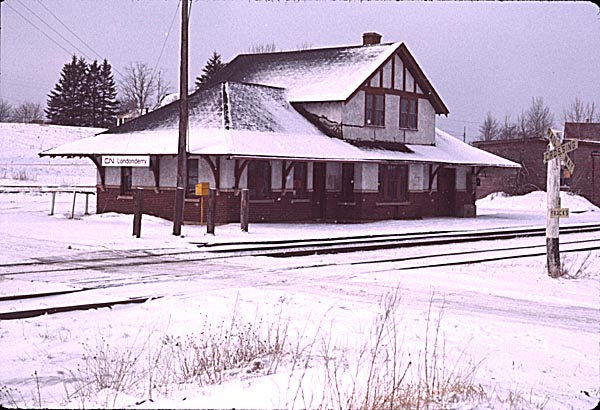 The Fucking CarSo how did we get from this solved problem to the mess we're in now? The car.And you can understand it. They didn't know the city would be blown apart by the car. There were a whole bunch of overlapping things that are hard to disentangle. How crazy were they? Please take a few minutes to check out these two videos from the dawn of the car-crazy era. These appear like some kind of extended joke to us now (if they don't appear that way to you, you probably want to stop reading now) but they were dead serious, this was the real capital-F Future they imagined.
Design for Dreaming (1956)
Disney (Disneyland TV) - Magic Highway USA (1958) Seriously. These people were out of their minds. They thought it was one step from curving ascending highways to flying cars and then rocket cars to the moon. They thought everything, without exception, should be automated, inconvenience eliminated, physical effort banished, spaces enclosed. Never go outside! Never walk! Man vs. Nature: The Road to Victory. It's hard for us to understand this - the people standing on moving sidewalks rather than walking from store to store, the car that flies right up to your office door - but we're simply too far removed. Washing used to be hard work. The washing machine was like a kind of miracle (as Hans Rosling argues in a great TED video). The car gave everyone transportation faster than a horse, more personal than a train. They had just crushed the Nazis with American jeeps and tanks and planes and bombs. American industry had saved the entire goddamn world. They were going to the moon. Can you imagine living at such a moment and not thinking you could just sweep away everything old, all the old musty city and build a shining new future? It's easy for us to sit in 2012 with fat kids and strip malls and cratered downtowns and wonder how they could have done this, but they seriously just saw it as another step, just more progress. The car replaced the train. The plane replaced the transatlantic liner. The bus would replace the tram. Everyone would be free, happy, rich, everyone a king in their own suburban mansion, commuting to shining city towers to work on space projects. You can see it in every frame of the above videos. They believed. No one sitting in their comfortable detached brick house in downtown Ottawa in 1950, living their comfortable middle-class life, walking and taking the trolley, thought "hey, let's add cars and turn this into a a bunch of crumbling crackhouses". They thought, out with the old, in with the flying cars and houses on the moon. And just about everyone made the same mistakes. The only difference is at what point they started to realise what they were doing, and work to undo the mess. And even then, even in the most difficult places to have a car, people love their fucking cars. In New York where it is incredibly inconvenient to have a car and a parking space might cost you as much as a Canadian suburban house, they love the car. In France, where you pay high gas taxes and high road tolls and high parking fees and you have endless transportation alternatives they love the car. Beautiful walkable transit-friendly Paris is jammed with cars. Stockholm is full of cars. In fact about the only place you can see the less-car world is in Copenhagen, where beautiful women glide slowly by on bicycles on quiet streets, like something out of a dream. So let's have no illusions that it is easy to eliminate the car. But you can work to provide the alternatives. You can learn from the disaster that was the 60s and 70s (and which continues unabated in many places in North America, to the point where mayors in 2011 triumphantly crow about "ending the war on the car" as if the car hadn't blitzkrieged pretty much every aspect of pre-WWII urban life and culture into utter annihilation). The TramIn France they got rid of all the trams... and then started rebuilding the tram lines again in the 90s. Wikipedia - List of town tramway systems in France tells the tale:Mulhouse: closed 1956, rebuilt 2006 Strasbourg: closed 1960, rebuilt 1994 Bordeaux: closed 1958, rebuilt 2003 Dijon: closed 1961, rebuilt 2012 (expected) Rouen: closed 1953, rebuilt 1994 Toulouse: closed 1957, rebuilt 2010 Valenciennes: closed 1966, rebuilt 2006 Nantes: closed 1958, rebuilt 1985 Nice: closed 1953, rebuilt 2007 Grenoble: closed 1952, rebuilt 1987 Lyon: closed 1956, rebuilt 2000 You get the idea. Meanwhile Ottawa: closed 1959, rebuilt ???? and no, that is NOT rebuilt 2017 or 2019 or whatever the Ottawa "LRT" date is. The old proposal, the previous proposal I tried to be very clear about the different transportation modes above, about the solved problem of transporting people, because it seems Ottawa is incapable of understanding this distinction. A train that runs above ground is not a tram. If it has stations far apart and is designed to move people from the suburbs in and out of the city core, it is commuter rail. Ottawa is building commuter rail. A little tiny bit of commuter rail. That's it. The LRT will do exactly zero for people living downtown who want to move around the city the way actual residents do, which is between neighbourhoods: from the Glebe, to Centretown, to Westboro, to the Market. Those are the places people who like the urban space want to go. The LRT will not get them to any of those places. The LRT is for jamming even more commuters even more quickly in and out of the CBD. That's it. Whatever shall we do?If you want to do a proper Ottawa (transportation slice), what you do is: 1. rebuild at least the S and B lines of the Ottawa trolley (Didn't know we had a trolley system? It covered the entire downtown, and since it was for residents, not suburban commuters, it connected together the neighbourhoods of the city -- to some extent it helped create the neighbourhoods of the city.)  2. Run commuter rail out to defined town centres. And that's it. None of this "park and ride" BS. You want to ride the train? LIVE NEAR THE TRAIN. 3. Run local rail to local towns (that means towns far beyond 20 minute commuting distance). 4. Run high-speed rail Montreal-Ottawa-Toronto. It will cost $9 billion and pay for itself. How do I know this? Because the federal government told me, although they buried that info so far in layers of clicks and bottoms of paragraphs you would never know it. Developing the section between Montreal-Ottawa-Toronto could cost between $9.1 [billion] for 200 km/h and $11 billion for 300 km/h. ... a project between Montreal, Ottawa and Toronto only could generate a positive net economic benefit at both 200 and 300 km/hUpdated Feasibility Study of a High Speed Rail Service in the Québec City – Windsor Corridor (November 14, 2011) - emphasis mine and the central station for all this rail activity should be, you know, the central train station: Ottawa Union Station. 5. And yes of course, do a loop around to Gatineau (although the weird 60s inward-facing Place du Portage "employment node" really should be torn down, which would reduce the number of public servants who need to do the loop around). And run rail to the airport. These are also obvious and there is dedicated rail to the airport in London, Paris, Stockholm etc. etc. 6. In the space you gain from reclaiming the public transportation space from cars, widen the sidewalks and provide cycling lanes. The high predictability of rails-bound trams means that they very comfortably mix with pedestrians and cyclists. You may have noticed that I didn't mention a subway - you only need a subway (which is enormously expensive) if there are long-haul distances within the city that your existing transportation network can't satisfy. So IF you build the entire tram network and you find a lot of people still aren't able to get around within a 20 minute tram-ride window, then you think about a subway. But the Ottawa core is small and a long way from densely populated - from e.g. LeBreton Flats to Riverside Park you're only talking what, 7km and only a few tens of thousands of people? It's pretty hard to justify the expense of a subway through kilometres of rock just to save a few people a few minutes of travel time around the core. The disconnect between what I see as a straightforward transportation plan and our inability to act as a city is a tiny fraction of what drives me insane about the NCC Horizons 2067 and Centretown Design Plan and Downtown Moves (and whatever the hell Choosing Our Future is). You don't need some effing panel of experts. You don't need to consult and re-consult and re-re-consult until 2013 to decide what you will do in FIFTY-FOUR years from now. Just this transportation slice is not only obvious, but could be done within the span of years, not decades. Don't spend $2 billion on 12km of commuter rail and think you've saved the city. All that does is encourage commuters to live FARTHER away, and rewards developers who will jam the cheapest, tallest, ugliest towers near-ish to stations and call it "transit-oriented development". Build a whole entire network. You don't need a single new idea. Just remember 1950s Ottawa, 1950s Canada, and 2012 Europe. You want to fix our little lumber town that was never a city in the first place, that is never going to be Paris or London in some undefined "G8 Capital" sense, but that is at least a more functional space than the created-from-nothing planned city artificial capitals like Brasilia and Canberra? Just revisit the prosperous, functional 1950s city where public servants lived downtown  bring back some of the infrastructure that enabled that, and add the modern infrastructure that we have learned about in the last SIXTY YEARS. While you're at it, you might want to end the insane fantasy that 2760 square km spanning from the woods to central condo towers is a "city". 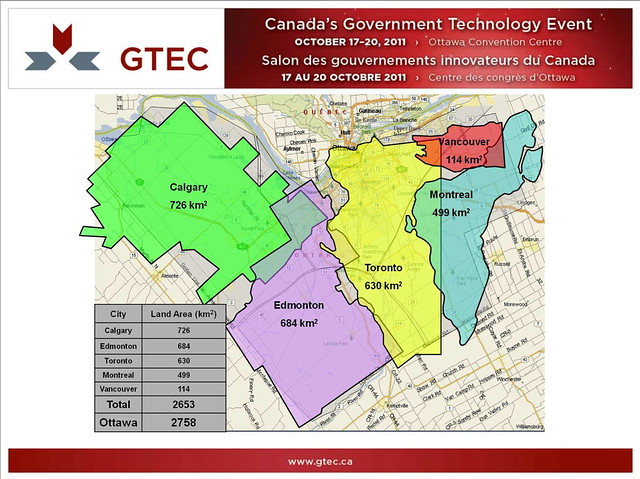 I have a lot more to say about the built-form issues and general suburban suck, but this is enough typing for now. Labels: ottawa, ottcity, rant, transportation planning, urban planning, urbanott, yow Thursday, January 19, 2012
Thoughts on Downtown Moves and Ottawa's urban future
The January 18, 2012 Downtown Moves Open House was a low-key event with discussions around display panels and large printed maps of the study area. I have posted photos of all the display panels (except for two where people put dots on their home & work addresses and problem areas for walking and cycling). Here are the display panels: Downtown Moves - Open House Jan 18, 2012. UPDATE: Now includes the five sections of the large handout from the event, at the end of the photo set. ENDUPDATE I was fortunate to have the opportunity to have a long chat with the city's planning lead on the project, Nelson Edwards. I spoke about the importance of having a lively streetlife, of having interest and activity in the lower three stories of buildings as they engage the street (Jan Gehl has said these lower levels are key, where people on the street can see what's going on above and vice-versa for people living above). Mr. Edwards has a very comprehensive perspective, but I worry that the Downtown Moves initiative is challenged with being all things to all people. At its very core, it's about taking advantage of the buses being (partially) replaced by underground LRT, so that the study area (the Central Business District) can both adapt to the new pedestrian flows, as well as becoming a better urban environment as a whole. You can get a sense of the challenge from the many, many "Strategic Directions" the project has declared for the study area:
I think the core thing to understand about the CBD is that it is not a failure. It was designed to be that paragon of Modernist planning: the single-use district. They believed in strict separation of their three functions: dwelling, work, and recreation. All to be tied together with their fourth function: transport. In practice what this resulted in was people living in detached single family homes out in the suburbs, with work clustered in "office parks" downtown and along highways, and recreational areas separated from both. They really thought that this idea of the city as a "machine" or "factory", where you would separate out each function and make it "more efficient" would lead to the best possible living, working, and playing environments. The modernists also thought that all functions of the city planning should be separate with parks planning separate from traffic engineering separate from etc. etc. Instead of this mechanistic, reductionist planning producing efficient paradises it created lifeless surburban zones where people stay inside their houses, connected to lifeless work zones where people stay inside their buildings, connected to recreational zones where people stay inside the stadium. And by "connected" meaning only highway upon highway as single-occupant cars rush from one "function" to another. And the idea of buildings actually engaging with their environment, being in a specific place with people flowing in and out at ground level becomes so alien and lost that all your buildings turn inward, with dead exteriors surrounding interior food courts and shopping; buildings that could be dropped anywhere. They were totally wrong. Hey, it happens. But the result is most Ottawa families living a car commute away outside the greenbelt in cookie-cutter suburbs sprawling outwards, a CBD that cars and transit rush as quickly into and as quickly out of as possible at 9 and at 5, a hockey stadium out in the middle of nowhere, and endless expense on the car transportation (and to a much lesser extent transit) network needed to connect these far flung islands together. Even the arts centre in the core of the city turns its back to the sidewalk, because who would ever arrive anywhere by foot? Instead it welcomes the car on the canal side, far away from the rabble of the street. Plus which Rideau Centre in typical inward facing "special zone" fashion sucks up all the destination retail. This would be hard enough if we had stopped doing it. But most housing still goes beyond the greenbelt. Most new buildings (e.g. 180 Kent) continue the same inward-facing food court mall placeless design that Place du Portage and L'esplanade Laurier exemplify. New condos are dropped in as vertical suburbs, single-use residential zones that could be anywhere, with no engagement with the street. And the entire thing is held together with a network of high-speed city core "arterial" roads that makes the entire downtown an offramp. To unwind this deliberate 1960s successful design, we need to stop 50 years of assumptions, engineering and design. Many cities started doing this over two decades ago in the 80s and 90s. We have barely started to attempt it now, in the second decade of the 21st century. It will be a long long walk home. We've got the bones (and culture) of a small town with a couple main streets. We've got the housing of a small town that was packed with middle-class government employees. (See Residence Distribution of Civil Servants, 1947 from the Gréber Plan.) And we have the design of a wave of 1960s brutalism, "urban renewal", and Modernism, that left us with a city core stripped of inhabitants, a street rail system that was erased from the map, and the suburbs, malls and associated car infrastructure that swept across North American cities. I see this most often in the endless discussions around Sparks. Sparks had surface rail running down the middle, with destination shopping (the Apple Stores and Lululemons of their age) on either side. It connected Lebreton Flats to Lowertown and to the destination shopping on Rideau Street. It was surrounded by a dense grid of housing for civil servants, shop keepers and all the people who live in a typical central town. Then they took away the rail, all the destination shopping went to Rideau Centre, they flattened Lebreton, Lowertown crumbled into a low-income disaster area (like most city cores), all the rest of the people living downtown fled to the suburbs, and they dropped cold inward-facing office towers around Sparks. And people wonder why it doesn't work? It's a wide pedestrian street that connects nothing to nothing, with no shopping and no people who live nearby. In a real world where people like to move along edges, and watch other people. Is this seriously hard for people to understand? It's a pedestrian street in the middle of what might as well be a suburban office park. OF COURSE NO ONE WALKS THERE. Look at the reality It's a bunch of offices (pink colour) 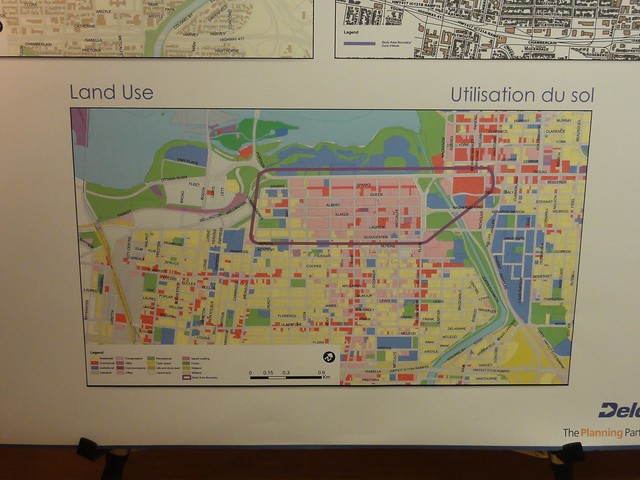
fed by a network of high-speed arterials (red lines) 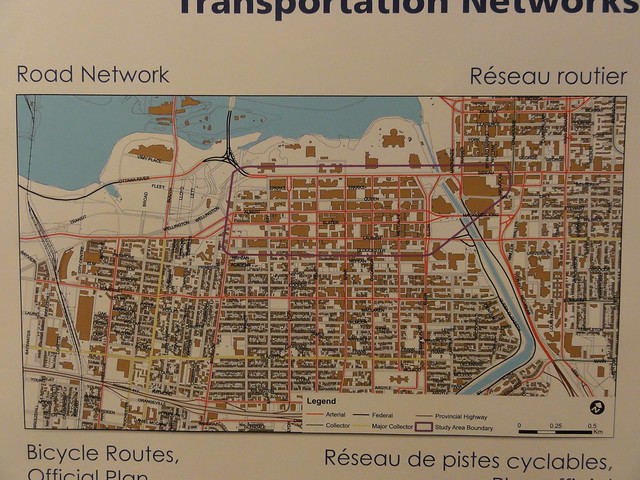 Dedicated zones like this, with public space (that is to say, the streets) dedicated only to ensuring people can drive in and out AS FAST AS POSSIBLE are Dead by Design. You might as well stand at a strip mall by the Queensway and wonder why it isn't like being in downtown Paris. It will take decades of effort to unwind this. For example, the single biggest thing you can do to make this a place for the people who actually live there is to slow down traffic. It is insane to have high-speed traffic in a downtown core, a centre-ville. Over 30km/h, cars vs. pedestrians and cars vs. cyclists ends with dead citizens. That means you have to signal to people, through road design (not through signage or laws, which people ignore), through the design of the streetscape itself, that they not on the safe wide highway, that they have to slow down and pay attention, that they are now not the lords of carland, they are visitors to a pedestrian zone. Just that alone, trying to narrow and slow streets, returning them to their pre-1950s widths with attractive street features and enough uncertainty so that drivers go slowly with care, will be a huge, incredible fight. How do I know this? Because King Edward already tried to do this, and Bronson is trying to do it now, and the traffic engineers return instead with ever-wider, ever-faster, ever-more-highwaylike designs. This is not surprising, they are TRAFFIC ENGINEERS. Their purpose is to make the cars go faster and the traffic flow smoothly. Expecting them to produce traffic-slowing pedestrian designs is like expecting a pastry chef to design an aircraft carrier. If the city believes "Rebalanced and Equitable" streets, that means rebalanced and equitable planning. That means for every traffic planner, there should be a pedestrian planner, a cycling planner, and a transit planner. That's how you actually get to "rebalanced". This is not about hating cars or towers. This is about building a city, not a giant strip mall. Urban design is different from suburban design. The role of the car downtown is different. The way residential towers need to engage with the street is different. For that matter, the way people need to think about their city and move around it is different. There is a big risk that, as with the dead street life around the apartment towers full of thousands of people on Laurier west of Kent, if we drop more towers on Nepean and Gladstone near Elgin without using design and education to convey to people that they are in a city where they can walk around, shop, and live outside in the city, we'll just end up with a downtown that has "foot commuters" who pour out of residential towers, up into officer towers, and back again, without ever stopping to experience the city they're actually in. If you think this is theoretical, there are thousands of units in condo towers already approved, with many of the towers under construction right now. 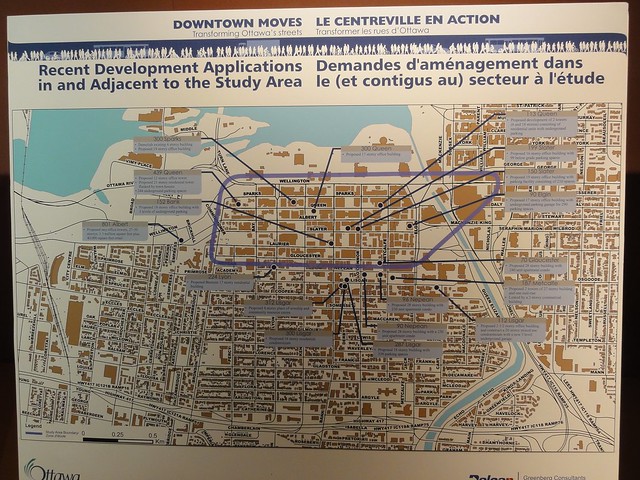 The only way I can see to chip away at this realistically is: 1) The city must hire more dedicated pedestrian, cycling and transit planners (it has already taken great stride in hiring cycling planning, but has zero pedestrian planners). 2) The city must convey the idea, both through explicit statements and implicit design, decade by decade, that cars are visitors to the downtown, not the owners of downtown, and that they are welcome only to the extent that they respectfully share public transportation space with other users 3) The city must have zoning it can ENFORCE, design it can ENFORCE, and plans that are actually followed, in a way that is comprehensible to ordinary humans (as opposed to the current situation where developers build whatever they want wherever they want to the lowest possible standard, and use layer upon layer of city, NCC and other planning documents to win their case every time at OMB) There is so much more than even these basic steps. This is basically the project of the redevelopment of the entire urban design for the city. I am skeptical about what can be accomplished. I hope at least that it can move on three fronts, with small "popup" demonstration projects, enforced standards for new buildings, and a long term plan to make the city environment better as buildings are replaced and streets are upgraded. You can reach Nelson at Nelson Edwards Planning and Growth Management Department Infrastructure Services and Community Sustainability City of Ottawa 110 Laurier Street West Ottawa, ON K1J 1P1 Tel: 613-580-2424 ext. 21290 Fax: 613-580-2459 e-mail: downtownmoves@ottawa.ca You can sign up for the Downtown Moves mailing list. The city's website section for the project itself is ottawa.ca/downtownmoves This is a huge change in city direction. It needs every citizen pushing their councillors, city staff, and engaging in the planning process to help it happen. Labels: dottmo, downtown moves, ottawa, urban planning Sunday, January 15, 2012
Downtown Moves meeting January 18, 2012
Downtown Moves, which is the new name for the Downtown Ottawa Mobility Overlay, is having its second meeting Wednesday, January 18, 2012 5:30 to 8:30 pm Ottawa City Hall, Jean Piggott Place, Main Floor 110 Laurier Avenue West This is the second in a series of public events that will provide residents with an understanding of the study, what it hopes to achieve and how it will transform Ottawa’s streets over the next 20 years.The short URL is ottawa.ca/downtownmoves I'm using the Twitter hashtag #dottmo for the initiative. The previous events were more like stage-setting presentations, they didn't really delve into the project itself and its goals. What I would like it to be is: transforming the Central Business District (CBD) from a Monday-Friday 9am & 5pm commuter suburb in the core of downtown to a pedestrian-friendly 24/7 core with streetlife, connected to the Market, Centretown (south of the CBD) and Lebreton Flats. What I expect it will actually be is: How can we move commuters coming to/from the LRT stations out of the way of cars and in/out of their work towers as quickly as possible, while making some minor concessions to the fact that there are no longer buses on Albert & Slater. This is particularly important as Claridge and others have built a lot of condos in the area recently and are continuing. Just in the next few years another 2000 or more condo units will come online, mostly dropped into the CBD in giant towers. In theory, Downtown Moves should take into consideration the Centretown Design Plan, most specifically the recommendations that the downtown core arterials (particularly Lyon, Kent, O'Connor and Metcalfe) be made two-way. However the study scope is so narrow (just the CBD, just related to post-LRT) that I fear the Design Plan ideas will be lost. The short URL for the CDP is ottawa.ca/midcentretown but most of the information is in their blog in particular their final post: The FINAL Centretown Community Design Plan Has Arrived! (I hope the blog is archived, as the site and URLs will surely expire at some point.) There are many other relevant documents including the Pedestrian Plan and the Cycling Plan. I thought Greenberg's presentation from the previous meeting was going to be posted online, but I can't find it. I captured an archive of the November events and livetweeted Greenberg: Downtown Moves - Nov 1-3 Twitter archive. His book Walking Home is excellent. Highly recommended. Covers how the suburbs ate the cities, and how we can walk our way back to lively, people-friendly urban design. Ottawa has had no shortage of outside experts providing us excellent advice on modern urbanism. Where it falls apart is in two places: 1) Implementation using our actual city staff in our actual city 2) Funding and defending our decisions (e.g. enforceable zoning rather than development-via-OMB). Sunday, November 20, 2011
Paris neighbourhoods
The situation is confusing because there are both numbers with matching names (the 20 arrondissements) as well as names for different areas (districts / quartiers) which don't map directly to one arrondissement. Sometimes when you're searching e.g. for hotels they will list only by arrondissement name, other times only by number, other times by area names. They're numbered in a spiral outwards - one through eight are kind of the inner core, after that they are progressively farther out. Here are the numbers and names 1 - Louvre 2 - Bourse 3 - Temple 4 - Hôtel-de-Ville 5 - Panthéon 6 - Luxembourg 7 - Palais-Bourbon 8 - Élysée 9 - Opéra 10 - Entrepôt, previously called Enclos Saint-Laurent 11 - Popincourt 12 - Reuilly 13 - Gobelins 14 - Observatoire 15 - Vaugirard 16 - Passy 17 - Batignolles-Monceau 18 - Butte-Montmartre 19 - Buttes-Chaumont 20 - Ménilmontant This is a very good quick guide, with maps: aviewoncities.com - Arrondissements of Paris Here are some districts: Île de la Cité and Île Saint-Louis (mostly in the 4th although the end of Île de la Cité is in the 1st) Châtelet-Les-Halles - can refer to a major transit station, the area around it, or a broader area in the 1er and 2e around where the old market (Les Halles) used to be Faubourg Saint-Honoré - street (and to some extent surrounding area) with famous shopping in the 8e Bastille / Place de la Bastille - touches the corners of the 4e, 11e and 12e Montmartre - in the 18e on and around the Butte-Montmartre Le Marais - covers some parts of the 3e and the 4e Saint-Germain-des-Prés / Faubourg Saint-Germain - in the 6th around the church of the former Abbey of Saint-Germain-des-Prés (see map and info Quartier Saint-Germain-des-Prés) Odéon - in the 6th centred around the théâtre de l'Odéon (see map Quartier de l'Odéon) Invalides & École Militaire - in the 7e around these landmarks Montparnasse - in the 14e around the Oberkampf (in the 11th) Trocadero (in the 16e) Latin Quarter - parts of 5e and 6e around the universities - see Quartier latin Canal Saint-Martin (in the 10th and 11th along the canal) Wikipedia - Paris Districts is a useful although incomplete guide. parislogue.com - Paris Neighborhoods is also useful. Friday, November 04, 2011
Downtown Moves - Nov 1-3 Twitter archive
Below is the raw extract of tweets hashtagged #dottmo Context: Ottawa.ca - Downtown Moves (Downtown Ottawa Mobility Overlay Study) Most of them are from the Ken Greenberg talk, I have separated out earlier ones at the top. These are in oldest first order. (In case you're wondering how I did this, I took the Excel version of the Twitter archive I made, and sorted by ascending TweetID. then copied the text.) Where the tweets are in order, just from me and the date is the same, I have removed my Twitter handle (@rakerman) and the time stamp. Tweets from before Ken Greenberg's talk@rakerman2011-11-01T11:15:54-04:00 questions: how Centretown Design #ccdp2011 Mobility relates to Downtown Moves #dottmo & Sidewalk Summit #ssdh http://t.co/OE8p55rY #ottcity I'm proposing #dottmo for Downtown Moves (hashtag = Downtown OTTawa MObility/MOves/Mobility Overlay) #ottcity @rakerman 2011-11-02T20:29:26-04:00 @OTWPolitics I suggested hashtag #dottmo @rakerman 2011-11-03T06:02:53-04:00 I will be using hashtag #dottmo for Downtown Moves / Mobility Overlay #ottcity #dottmo MT @OTWPolitics: For those who can't make it to City Hall tonight, Ken Greenberg's talking urban rejuvenation on @CBCOttawa @Centretowner 2011-11-03T08:19:33-04:00 RT @rakerman: I will be using hashtag #dottmo for Downtown Moves / Mobility Overlay #ottcity @Centretowner 2011-11-03T09:10:47-04:00 Anyone else tweeting from Downtown Moves talk by Andrew Wiley-Schwartz? #Ottcity #dottmo #ottbike @Centretowner 2011-11-03T09:12:44-04:00 Coun. @marianne4kanata talking about making our roads safer, and @JimWatsonOttawa signing Int'l walking charter #dottmo @JimWatsonOttawa 2011-11-03T09:24:34-04:00 RT @Centretowner: Coun. @marianne4kanata talking about making our roads safer, and @JimWatsonOttawa signing Int'l walking charter #dottmo @lana_stewart 2011-11-03T09:35:37-04:00 @Centretowner @rakerman They talk the talk... but will they walk the walk?? #ottcity #dottmo @Centretowner 2011-11-03T09:39:06-04:00 AWS's #dottmo talk about what NYC did at Times Square reminds me of what #Ottcity did in the '60s with Sparks St Ken Greenberg spoke November 3, 2011 at 7pm at City Hall. Context: Ottawa.ca - Downtown Moves - Public Lecture Program Ken Greenberg's talk@rakerman2011-11-03T19:01:15-04:00 #dottmo just opening - Ken Greenberg talking about book #dottmo "we were swept up in a euphoria around the potential of the automobile" #dottmo 1939 World's Fair - GM exhibit - "it seemed like a good idea at the time" #dottmo "the hubris of that era... The automobile was at the heart of it" #dottmo Disney Magic Highway USA 1958 #dottmo the summary of the Disney film is people were out of their minds (about cars) in the 1950s #dottmo from walkable cities to car-oriented cities #dottmo Jane Jacobs vs Robert Moses #dottmo as walkability becomes the most desired, poor are pushed out of city centers into suburbs #dottmo (car-centic design) producing a pattern of living that is not sustainable #dottmo massive financial drag on economy related to congestion, long car travel times #dottmo website: dead malls (symptom of car-oriented design failing) #dottmo "the best way to solve mobility is through land use" #dottmo need mixed use buildings #dottmo Bank Street Ottawa transformation #dottmo how to handle new immigrants - they are now ending up in suburbs - disconnected, difficult to get around #dottmo (me: in part this is about the Arrival City idea) #dottmo showing transformation of NYC Times Square #dottmo Madrid has buried city-centre highways #dottmo new ways to get around - bike share, car share, phone as access/payment for all forms of transportation #dottmo showing a Complete Streets design #dottmo if kids can bike to school, that's a good indicator #dottmo urban design to percentage of pedestrians using the space - temporary or permanent pedestrianization of roadways #dottmo Hammarby Sjostad http://t.co/vRFX82t5 #dottmo the next big challenge: retrofitting suburbia #dottmo #ottcity is there a link for the Bank Street redesign Ken is talking about? #dottmo restructuring around subway stops coming to York U #dottmo Mississauga "looks like a city... But on the ground it's auto-oriented" #dottmo "at the heart of a sustainable future is gracefully making this transition" to a pedestrian/cyclist/transit city #dottmo civil society needs to support these changes #dottmo iterate solutions with teams of experts to solve complex urban design problems #dottmo big turnout, mailing list I can sign up for, but not at all clear how people can participate, not just receive broadcasts #ottcity #dottmo I guess Ken Greenberg was talking about: Bank Street Community Design Plan http://t.co/u38bi6xL 1st I've heard of it. #ottcity #dottmo Here's the Disney Magic Highway video that Ken showed, demonstrating how crazy people were over cars in 1958 http://t.co/ZMSDVvWj Further ReadingI think this is what the Mayor signed: The International Charter for WalkingRandomHouse.ca - Ken Greenberg - Walking Home: The Life and Lessons of a City Builder LibraryThing - Walking Home: The Life and Lessons of a City Builder Wired 15.12 - The Original Futurama [GM 1939 World's Fair exhibit] Wikipedia - Jane Jacobs - The Death and Life of Great American Cities RandomHouse.com - Wrestling with Moses: How Jane Jacobs Took On New York's Master Builder and Transformed the American City LibraryThing - Wrestling with Moses: How Jane Jacobs Took On New York's Master Builder and Transformed the American City Arrival City: The Final Migration and the Next World US National Complete Streets Coalition Complete Streets Canada I would point you to a fantastic video of Jan Gehl talking in Ottawa about urban design, but the NCC reorganised their site and it has now disappeared. You can see his slidedeck but it's almost useless without his (very funny) narration. You can also follow the thread of blog postings back from Jan Gehl presentation about urban planning in Ottawa - October 6, 2010 but many of the links are now broken. ContactThere is a general contact address: downtownmoves@ottawa.caand the specific project manager is Nelson Edwards: nelson.edwards@ottawa.ca There was a mailing list you could sign up for at the event; you can probably get on it by emailing them. Nelson said on the afternoon of the 3rd there was a 40-person discussion / working group, but I don't know who the members were or how the results will be presented. Also Greenberg's presentation was recorded in some form - I think video - there was mention of a "podcast" of it being posted. Previously: November 1, 2011 questions about downtown mobility [now with answers] Labels: centretown, dottmo, downtown mobility, downtown moves, links to presentations, ottawa, presentation notes Wednesday, November 02, 2011
Ottawa - Centretown walkability
As you walk around town between now and November 8th, consider the following topics and if possible please bring a list of 5 examples in each category.Here are a couple: * The Bank Street advertising monoliths that block half of the sidewalk * The traffic signal control nodes (big boxes, usually sitting on a metal column) that block half of the sidewalk Labels: centretown, ottawa, urban planning HOME - |